Header — TechRadiant Floating Pill
Best FDA-Compliant Software Development Companies 2026 — TechRadiant
FDA Compliance 10 Vetted Companies 2026 Rankings

Best FDA-Compliant Software Development Companies

We evaluated 50+ medical device and SaMD software development firms across FDA regulatory expertise, 510(k) and De Novo submission track record, IEC 62304 software lifecycle compliance, clinical validation rigor, and quality management system maturity — to surface the 10 software development companies best equipped to design, build, and clear FDA-regulated Software as a Medical Device (SaMD) and software-enabled medical devices for US and global markets in 2026.

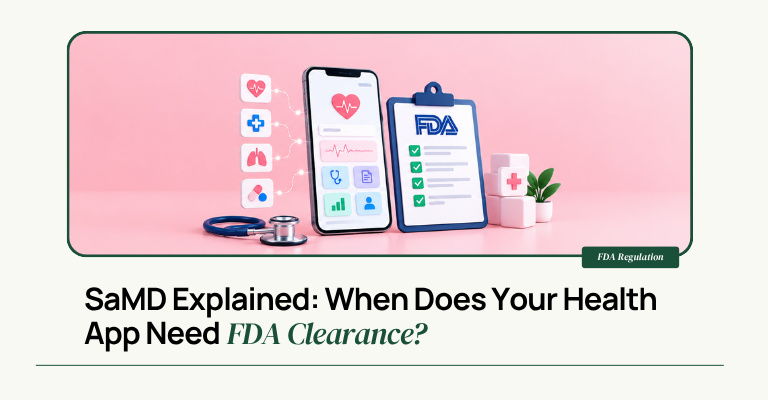
What is FDA-compliant software development? FDA-compliant software development is the discipline of building medical software — including Software as a Medical Device (SaMD) and Software in a Medical Device (SiMD) — according to the regulatory framework established by the US Food and Drug Administration. This encompasses proper SaMD risk classification under FDA guidance (Class I, II, or III), adherence to the IMDRF SaMD framework, implementation of IEC 62304 software development lifecycle requirements, preparation of a Software Description Document (SDD) and Software Requirements Specification (SRS), comprehensive verification and validation (V&V) testing documentation for the Design History File (DHF), and compliance with FDA's 2023 cybersecurity guidance for medical devices. For Class II devices, FDA-compliant software development culminates in a 510(k) Premarket Notification submission demonstrating substantial equivalence to a predicate device. True FDA-compliant software development firms embed regulatory strategy into every sprint — not as a final audit step, but as a core engineering discipline that prevents costly rework and rejection at submission.
Report Details
CategoryFDA SaMD Dev
Companies10 Vetted
Edition2026
UpdatedOct 2026
MethodExpert-Reviewed
$612B
Global medical device market projected by 2030
73%
Of Class II 510(k) submissions now include a significant software component
3.2×
Faster FDA clearance for submissions with IEC 62304-compliant documentation
$8.4M
Average cost of a software-related medical device recall or Class II correction
47%
Of FDA warning letters that cite inadequate software development lifecycle controls
✓FDA 510(k) & De Novo Premarket Submission
✓IEC 62304 Software Lifecycle Compliance
✓SaMD Risk Classification & Design Controls
✓FDA Cybersecurity by Design (2023 Guidance)
✓DHF, SRS & V&V Documentation
✦
Our methodology evaluates FDA-compliant software development companies across five dimensions: FDA Regulatory Expertise (SaMD classification proficiency, 510(k)/De Novo submission experience, FDA correspondence track record, and Quality System Regulation knowledge); SaMD/510(k) Track Record (number and class of cleared devices, submission acceptance rates, and post-market software change management); IEC 62304 Compliance (software lifecycle process implementation, documentation rigor, unit/integration/system testing completeness, and traceability matrices); Clinical Validation (clinical study support, usability engineering per IEC 62366, and human factors documentation); and Quality Management System maturity (ISO 13485 certification, design control process, CAPA infrastructure, and DHF completeness). All rankings are independently researched — TechRadiant does not accept payment for placement.
Best FDA-Compliant Software Development Companies — Rankings 1–5
✦ 10 Companies Ranked

The best FDA-compliant software development companies

#1 RANKED
Top Pick
🇺🇸 Chicago, IL · Est. 2012 · ~80 employees

Orthogonal is widely regarded as one of the most specialized FDA SaMD software development firms in the US, with a practice built entirely around building software for regulated medical devices. Their team combines software engineers, regulatory affairs specialists, and quality engineers who treat IEC 62304, FDA 21 CFR Part 820, and FDA cybersecurity guidance as first-class development requirements — not post-build compliance audits. Orthogonal has a strong 510(k) submission track record across Class II SaMD applications in diagnostics, clinical decision support, and AI/ML-enabled devices, and is particularly cited for the completeness and FDA-readiness of their Design History File documentation.

SaMD & 510(k) Specialist Development IEC 62304 & FDA Cybersecurity Guidance AI/ML-Enabled Medical Device Software
FDA Regulatory Expertise
9.8
SaMD/510(k) Track Record
9.6
IEC 62304 Compliance
9.8
Clinical Validation
9.2
Quality Management
9.6
#2 RANKED
Top Pick
🇺🇸 Seattle, WA · Est. 2001 · ~120 employees

StarFish Medical is a full-service medical device development firm with deep FDA software expertise, serving health technology companies across the US and Canada. Their multidisciplinary teams encompass software engineers, regulatory specialists, mechanical engineers, and quality assurance professionals who collaborate within an ISO 13485-certified quality management system. StarFish Medical's FDA software practice covers SaMD classification, IEC 62304-compliant software development lifecycle, Design History File preparation, and 510(k) premarket notification support — backed by over two decades of cleared medical device submissions across cardiology, ophthalmology, diagnostics, and digital health.

Full-Service Medical Device Software Dev ISO 13485-Certified Development Process 510(k) Submission & Regulatory Strategy
FDA Regulatory Expertise
9.6
SaMD/510(k) Track Record
9.4
IEC 62304 Compliance
9.6
Clinical Validation
9.4
Quality Management
9.6
#3 RANKED
Top Pick
🇺🇸 Bedford, NH · Est. 1999 · ~80 employees

Sunrise Labs is a New Hampshire-based medical device development firm with over 25 years of FDA-regulated software engineering experience. Their engineering team works exclusively on FDA-regulated medical device projects — providing embedded software, firmware, SaMD, and connected health application development within a structured IEC 62304 and FDA 21 CFR Part 820 quality framework. Sunrise Labs has supported numerous 510(k) clearances and PMA supplements across Class I, II, and III devices, with particular expertise in device connectivity, wireless medical devices, and cloud-connected SaMD requiring FDA cybersecurity documentation per the 2023 Refuse to Accept guidance.

Embedded & Firmware Medical Device Software Connected & Wireless Medical Device Development FDA Cybersecurity Documentation & Compliance
FDA Regulatory Expertise
9.4
SaMD/510(k) Track Record
9.4
IEC 62304 Compliance
9.4
Clinical Validation
9.0
Quality Management
9.2
#4 RANKED
Verified
🇺🇸 Houston, TX · Est. 2012 · ~100 employees

Velentium is a Houston-based medical device engineering firm specializing in FDA-regulated software and firmware development for life-critical medical devices, including implantable, Class III, and PMA-pathway devices. Their team has deep experience building device software that must satisfy the most stringent levels of IEC 62304 safety classification — Class C software — where complete traceability from requirements through verification and validation is non-negotiable. Velentium's regulatory affairs practice supports full lifecycle documentation for FDA submissions, and their quality management system is built to support both 510(k) premarket notifications and PMA premarket approvals across cardiology, neurology, and patient monitoring device categories.

Life-Critical & Implantable Device Software IEC 62304 Class C Safety-Critical Dev PMA & 510(k) Submission Support
FDA Regulatory Expertise
9.2
SaMD/510(k) Track Record
9.0
IEC 62304 Compliance
9.4
Clinical Validation
9.0
Quality Management
9.2
#5 RANKED
Verified
🇺🇸 Milford, MA · Est. 2012 · ~80 employees

MedAcuity is a Massachusetts-based medical device design and development consultancy with a strong FDA software engineering practice. Their team of engineers and regulatory specialists works within an ISO 13485-certified QMS to build FDA-regulated software for diagnostic devices, surgical tools, patient monitoring systems, and digital health applications. MedAcuity's particular strength lies in human factors engineering and IEC 62366 usability validation — producing formative and summative usability studies that meet FDA's increasing expectations for HFE documentation in 510(k) submissions, particularly for software-intensive medical devices where user interface safety is a regulatory focus.

Human Factors Engineering & IEC 62366 Diagnostic & Patient Monitoring Device Software ISO 13485 QMS & Design Controls
FDA Regulatory Expertise
8.8
SaMD/510(k) Track Record
8.6
IEC 62304 Compliance
9.0
Clinical Validation
9.2
Quality Management
9.0
Mid-List CTA — TechRadiant
Free matching service

Not sure which
FDA-Compliant Software Development Companies fits your project?

Tell us your requirements once. We'll send you a curated shortlist of verified FDA-Compliant Software Development Companies — matched to your industry, budget, and timeline.

Share your project →
What you get
✓ A shortlist of 3–5 verified FDA-Compliant Software Development Companies matched to your specific project needs
✓ Filtered by budget, location, and industry — no irrelevant suggestions
✓ Response within 48 hours — no calls, no forms, no back-and-forth
✓ 100% free for businesses — you connect directly with the firms you choose
✦

Human-curated, not algorithm-generated. Every shortlist is reviewed by our research team before it reaches you.

Best FDA-Compliant Software Development Companies — Rankings 6–10
Verified
🇺🇸 St. Paul, MN · Est. 1996 · ~500 employees

Minnetronix Medical is a Minnesota-based medical device contract development and manufacturing organization (CDMO) with extensive FDA software engineering capabilities. Their development teams build FDA-regulated software for high-acuity medical devices — including surgical energy systems, capital equipment, and implantable device accessories — within a rigorous ISO 13485-certified quality system. Minnetronix Medical's software practice covers embedded firmware, host software, and cloud connectivity across IEC 62304 safety classifications, with in-house regulatory affairs specialists supporting 510(k) and PMA documentation and FDA correspondence management.

Medical Device CDMO with Software Practice Surgical & Capital Equipment Firmware 510(k) & PMA Regulatory Documentation
FDA Regulatory Expertise
8.6
SaMD/510(k) Track Record
8.8
IEC 62304 Compliance
8.8
Clinical Validation
8.4
Quality Management
9.0
#7 RANKED
Verified
🇺🇸 Houston, TX · Est. 1991 · ~400 employees

Softeq is a hardware and software development firm with a well-established FDA medical device software practice covering IoT-connected devices, wearables, and SaMD applications. Their medical team builds software across embedded, mobile, and cloud tiers — implementing FDA-required documentation including Software Requirements Specifications, architecture descriptions, traceability matrices, and V&V test protocols as deliverables alongside working software. Softeq's Houston headquarters serves US medical device OEMs seeking an experienced FDA software partner with full embedded-to-cloud development capabilities and ISO 13485 quality infrastructure.

IoT Medical Device & Wearable Software Embedded-to-Cloud SaMD Architecture FDA V&V Documentation & Traceability
FDA Regulatory Expertise
8.4
SaMD/510(k) Track Record
8.2
IEC 62304 Compliance
8.6
Clinical Validation
8.0
Quality Management
8.6
#8 RANKED
Verified
🇺🇸 Eden Prairie, MN · Est. 2012 · ~80 employees

Devicix is a Minnesota-based medical device development firm offering FDA-regulated software engineering within a structured design control framework. Their engineering teams specialize in embedded software, firmware, and wireless connectivity for Class I and Class II FDA-regulated medical devices — implementing IEC 62304 software development lifecycle processes and producing complete Design History File documentation. Devicix serves medical device startups and growth-stage companies seeking an experienced FDA development partner that can take a concept through verification testing, design freeze, and 510(k) submission readiness.

Class I & II Medical Device Embedded Software Wireless Connectivity & Device Communication Design History File & 510(k) Readiness
FDA Regulatory Expertise
8.2
SaMD/510(k) Track Record
8.0
IEC 62304 Compliance
8.4
Clinical Validation
7.8
Quality Management
8.4
Verified
🇺🇸 Bellevue, WA · Est. 1994 · ~200 employees

Bsquare Corporation is a technology solutions firm with a healthcare and medical device software practice spanning IoT device software, Windows-based medical device applications, and connected health platforms. Their development teams bring FDA regulatory awareness to embedded and application software projects — supporting IEC 62304 documentation, requirements traceability, and quality system integration. Bsquare is a practical choice for medical device manufacturers developing software for Windows-based diagnostic workstations, patient monitoring systems, and connected medical equipment requiring FDA software documentation and validation.

Windows-Based Medical Device Software Connected Medical Equipment & IoT FDA Software Documentation & Validation
FDA Regulatory Expertise
8.0
SaMD/510(k) Track Record
7.8
IEC 62304 Compliance
8.2
Clinical Validation
7.6
Quality Management
8.2
#10 RANKED
Verified
🇺🇸 Indianapolis, IN · Est. 2013 · ~200 employees

Greenlight Guru is the leading Quality Management System (QMS) platform purpose-built for FDA-regulated medical device companies — and a valuable partner for software development teams seeking structured FDA compliance infrastructure. While primarily a SaaS platform, Greenlight Guru's services arm provides FDA regulatory consulting, Design History File implementation support, and 510(k) submission preparation guidance specifically tailored to software-intensive medical devices. Their platform and advisory services help software development teams implement IEC 62304-aligned documentation, manage design controls, and maintain audit-ready compliance records throughout the device software lifecycle.


Medical Device QMS Platform & Consulting DHF & 510(k) Submission Preparation FDA Design Control & CAPA Management
FDA Regulatory Expertise
8.6
SaMD/510(k) Track Record
7.6
IEC 62304 Compliance
8.0
Clinical Validation
7.6
Quality Management
9.2
Report Bottom CTA — TechRadiant
Free for businesses

Not sure which agency
is right for your project?

Share your requirements once. Our research team will send you a curated shortlist of verified agencies — matched to your industry, budget, and timeline. No calls, no spam.

Matched in 48 hours Human-curated 100% free No back-and-forth
Share your project → List your agency Reviewed by our team · Not automated
FDA-Compliant Software Development FAQ — TechRadiant
FAQ

FDA Software Development — Compliance Questions

Common questions on SaMD classification, 510(k) premarket notification requirements, IEC 62304 software lifecycle standards, FDA cybersecurity guidance for medical devices, development timelines and costs, and how TechRadiant ranks FDA-compliant software development companies.

Software as a Medical Device (SaMD) is defined by the IMDRF as software intended to be used for one or more medical purposes that performs those purposes without being part of a hardware medical device. Under FDA's framework, software qualifies as SaMD when it is intended to diagnose, treat, prevent, or monitor a disease or condition — regardless of whether it runs on a smartphone, cloud server, or hospital workstation. Examples include clinical decision support software that interprets patient data to recommend treatments, AI algorithms that analyze medical images for pathology, remote patient monitoring software that detects deterioration, and software that calculates medication dosing. Software that merely enables administrative healthcare functions (scheduling, billing) or general wellness tracking is generally not SaMD. If your software processes patient-specific data to influence a clinical decision, assume FDA oversight applies and consult with a regulatory affairs specialist before development begins.
A 510(k) premarket notification is the FDA submission pathway for Class II medical devices — demonstrating that a new device is substantially equivalent to a legally marketed predicate device. Most Class II SaMD applications require a 510(k) before they can be legally marketed in the United States. The submission must include a software documentation package per FDA guidance: a Software Description Document, requirements and architecture documentation, and V&V test records. FDA's 2023 Cybersecurity Guidance also requires a Software Bill of Materials (SBOM) and a cybersecurity management plan. Class I SaMD may be exempt from premarket notification; Class III devices require the more rigorous Premarket Approval (PMA) pathway. The Breakthrough Device Designation program offers an expedited pathway for software that provides more effective diagnosis or treatment of life-threatening conditions.
IEC 62304 is the international standard for medical device software development lifecycle processes — defining the planning, development, maintenance, risk management, and configuration management activities required for software in medical devices. While FDA does not explicitly mandate IEC 62304, FDA's guidance expects software development processes equivalent in rigor to what IEC 62304 defines. In practice, FDA reviewers are familiar with IEC 62304's safety classification system (Class A, B, C) based on severity of harm, and submissions organized around IEC 62304 deliverables are reviewed more efficiently and accepted more consistently. IEC 62304 also interfaces with IEC 62366 (usability engineering), ISO 14971 (risk management), and ISO 13485 (quality management systems) to form the complete FDA-expected framework for software-intensive medical devices. Development firms not built on IEC 62304 typically produce documentation that fails FDA review at the first submission attempt.
FDA issued its final Cybersecurity in Medical Devices guidance in September 2023, establishing cybersecurity as a premarket requirement for internet-connected medical devices. Under the Consolidated Appropriations Act of 2023 (Section 3305), device manufacturers submitting 510(k), De Novo, or PMA applications for cyber devices must include: a Software Bill of Materials (SBOM) listing all commercial, open-source, and off-the-shelf software components; a threat model (STRIDE or DREAD methodology); a security risk assessment aligned to NIST Cybersecurity Framework; and a cybersecurity management plan covering post-market vulnerability monitoring and coordinated disclosure. FDA may issue a Refuse to Accept (RTA) for submissions that don't include complete cybersecurity documentation. Best-practice FDA-compliant software developers integrate these requirements at the architecture phase — designing secure communication protocols, authentication frameworks, and update mechanisms before writing application code.
FDA's statutory review goal for 510(k) submissions is 90 days from acceptance, but the real-world timeline is significantly longer. In recent years, the median total time from submission to clearance has ranged from 6 to 18 months, with software-intensive devices often at the longer end due to the complexity of software documentation review. The process involves: a 15-day Refuse to Accept (RTA) review; substantive review by the assigned FDA reviewer (30–90 days); potential Additional Information (AI) requests adding 90-day response windows; and a clearance decision. Incomplete software documentation — poorly organized requirements, missing traceability matrices, or inadequate cybersecurity documentation — is one of the most common causes of AI requests and delays. Development firms with strong 510(k) track records can reduce total time to clearance by 3–6 months compared to firms with limited FDA experience.
FDA's software documentation guidance scales requirements by the device's Level of Concern (LOC). Major LOC (serious injury or death risk) requires the full package: Software Requirements Specification (SRS), software architecture description, software design specification, software development environment description, V&V testing and protocols with traceability to requirements, revision history, and unresolved anomalies documentation. For AI/ML-based SaMD, FDA's Action Plan adds a Predetermined Change Control Plan (PCCP) requirement. The Design History File (DHF) — the master compliance record — must be maintained throughout the device lifecycle. FDA-compliant development firms produce all of these documents as routine development outputs. For AI/ML-based SaMD, a PCCP documenting planned algorithm updates and associated validation is also expected in the submission package.
FDA-compliant SaMD development costs significantly more than standard software development, reflecting regulatory engineering overhead and documentation requirements. A Class II SaMD application (mobile app, cloud-based clinical decision support, or diagnostic software) typically costs $300,000 to $800,000 from requirements through 510(k) submission readiness with a specialized US-based FDA firm. Complex SaMD with AI/ML components or novel indications can run $800,000 to $2M+. The regulatory overhead — IEC 62304 documentation, risk management, V&V protocols, cybersecurity documentation, and DHF maintenance — typically represents 20–35% of total development cost. Budget separately for regulatory affairs consulting ($10,000–$40,000), FDA submission fees ($26,000–$130,000+ depending on company size), and post-clearance software change documentation. The average cost of a software-related medical device recall ($8.4M) makes upfront compliance investment straightforward to justify.
TechRadiant evaluates FDA-compliant software development companies across five independently scored dimensions: FDA Regulatory Expertise (SaMD classification proficiency, 510(k) and De Novo submission strategy experience, FDA correspondence quality, and Quality System Regulation knowledge); SaMD/510(k) Track Record (number and regulatory class of cleared or approved software-based devices, first-submission acceptance rates, and post-market software change management experience); IEC 62304 Compliance (software lifecycle process implementation completeness, documentation rigor including SRS, architecture, V&V protocols, and traceability matrix quality); Clinical Validation (clinical study design support, IEC 62366 usability engineering capability, human factors documentation, and AI/ML evidence generation); and Quality Management System maturity (ISO 13485 certification status, design control process quality, CAPA infrastructure, DHF completeness, and audit-readiness track record). All rankings are independently researched — TechRadiant does not accept payment for placement or higher scores.
Not sure which FDA-compliant software development firm fits your project? Our advisors help you navigate SaMD classification, 510(k) requirements, and select the right development partner.
Get Free Guidance →
Featured Reports — TechRadiant